

Media in Motion: The Evolving Public Square
A new series: Field notes on how the emerging media ecosystem is redrawing democracy — and why philanthropy can no longer sit it out.

Athens had its agora, Revolutionary America its broadsides, and the 20th century its fireside chats and evening news. In every era of history, democracy has evolved alongside communication – not just in how elected leaders campaign, but in how humans organize, build community, and govern. These are the building blocks of democracy.
The printing press and pamphlets shaped the Constitution; television reshaped Americans’ views on Civil Rights. Each new medium doesn’t just change how we talk – it also redraws the public square itself. Misinformation is as old as the medium that carries it.
One distinctive quality of this moment, however, is the sheer pace of change; we’ve hit light-speed.
It took two millennia to crawl from scrolls to the printing press; it took a few decades to hop from radio to television. In thirty years, however, we’ve raced from websites and emails to blogs and SMS to vertical video and AI. This pace will not slow anytime soon. In fact, our emerging technologies and economic system will ensure it.
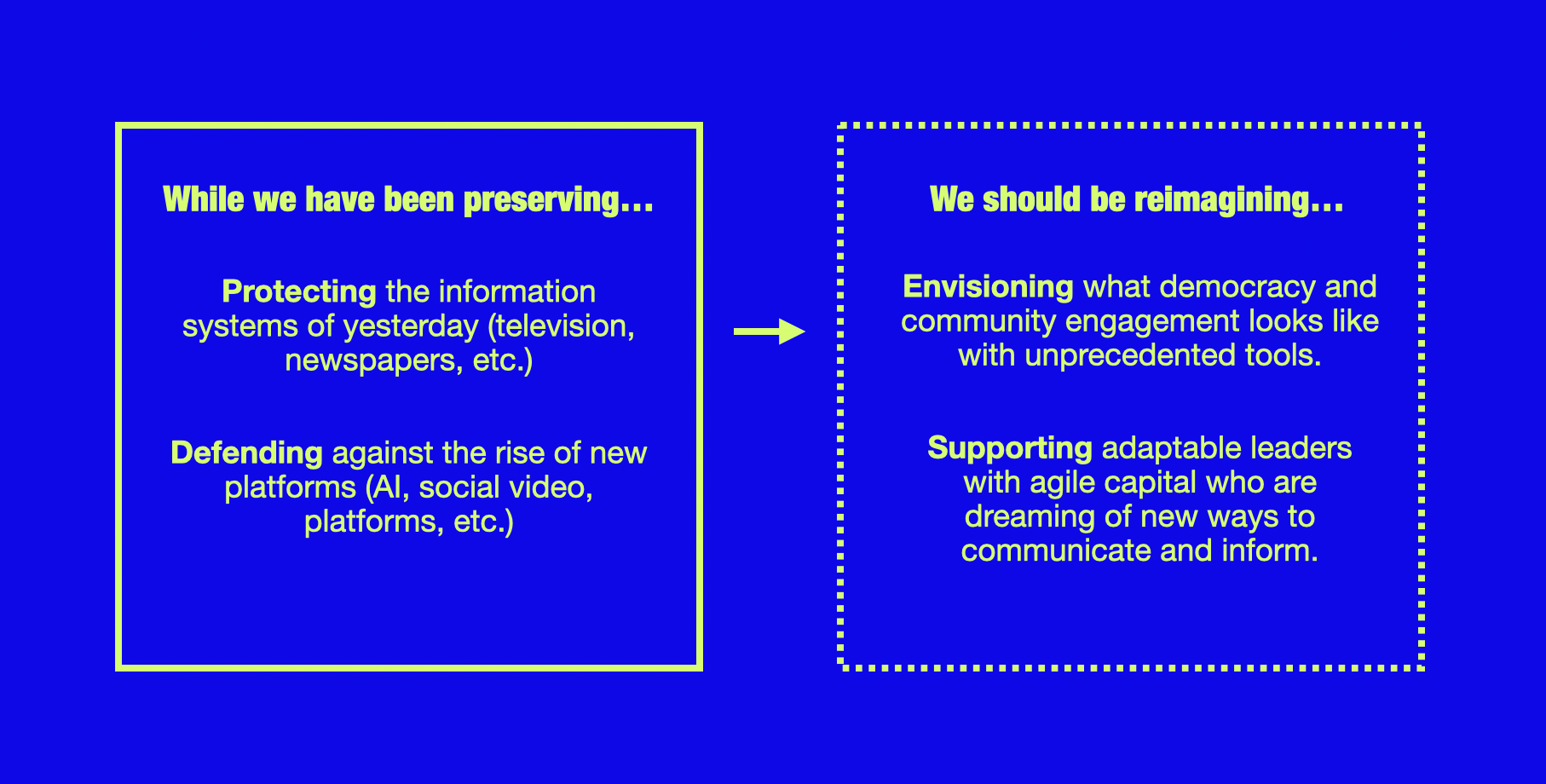
If we believe in self-governance, we must embrace this increasing pace of open communication and support adaptable leaders with agile capital to meet the moment and imagine what’s next. To put it plainly: pro-democratic forces are largely absent from many of the communications spaces where the future of democracy is being shaped.
Over the last decade, billions of dollars were spent on declining forms of one-way communication – like broadcast and traditional advertising – while anti-democratic forces continued to experiment aggressively with new media. We’re now living in the reality of what their imagination has wrought.
Too often, the movement for more just and equitable self-governance has treated the internet only as a problem to solve, rather than a place to create and grow audiences. We must stop studying media and start making it.
We can no longer be the referee – we need to join the match.
1. Bet on Dynamic Leadership
If someone suggests, “there’s only one tactic that will better engage Americans” – be that creators or clipping or channel acquisitions – stay cautious. We need it all, but even more importantly, we will need to constantly adjust to inevitable changes. The new communications landscape demands organizational leadership that’s willing to adapt and learn constantly. Platforms will continue to change, as will their features and what they reward. Just ask anyone who bet their business on the Facebook algorithm.
Invest in leaders who treat platforms like lab equipment. They run experiments, measure, discard, and iterate. But this is a mindset that’s not academic; it’s entrepreneurial. That is why many of the most consequential social impact programs of this next decade will not be “grantees”; they’ll be founders. They may not be non-profits. These leaders will create new entities, spin up new channels, sunset them, cultivate unexpected partnerships, and relentlessly test.
As you consider which organizations you might resource, evaluate the openness of the people you’re looking to support. Effectiveness in this era lies with leaders who refine their plans and adapt their tools over time, instead of playing it safe to secure funding. This doesn’t mean resourcing people who constantly spin their wheels. It’s important to back individuals who have a deep “why” and laser focus on an audience that will ground their efforts. An aligned acquisition, partnership, or technological shift may unexpectedly pop up, even outside of the best-laid plans.
The field hasn’t yet embraced enough people with media and technology backgrounds. They’ve already lived the relentless pace of change. We need to put up the bat signal for a wave of experienced media operators to join forces with the social impact leaders in our field. Hollywood, digital outlets, and tech are all shedding talent — let’s scoop up their most creative operators and storytellers.
2. Create Adaptive Partnerships
If communications are evolving at light-speed, funding can’t operate at committee-speed. Philanthropy’s traditional cadence of long planning periods was designed for a different era. A two-year planning process means the media world has entirely shifted before the endpoint. Frontier AI labs don’t even know what they’re doing six months from now. Today’s communications investments must be as fluid and agile as the technologies we have the potential to harness.
When the kinds of leaders we support begin to shift, so too must the capital that fuels their work. Rather than year-long, project-based grants tied to single narrative outcomes, support a leader who deeply understands an audience. Back that organization not because they’ve promised a tidy outcome, but because they know how to make content people actually watch or have relationships with powerful messengers. This calls for multi-year investments in teams with strong North Stars, not multi-year strategies.
They will need flexibility to pivot in order to succeed with their goals, not their grant proposal. Support them to experiment, grow, and deepen connections with their community. They might need to deploy unexpected tactics not initially imagined in a one-off pitch.
Tying long-term audience development to short-term metrics like randomized controlled trials or cost-per-vote calculations will not work. This work demands iteration, experimentation, brand-building, relationship development, and financial sustainability. The long-term value of a messenger can’t be measured in a lab at one point in time.
3. Center Trusted Messengers
I feel it too: the pace of innovation is exhausting. Yet there are handholds that keep us grounded in moments of rapid change. One of the most powerful is investing in trusted messengers. Identify efforts that center people – not transactional paid ads or platforms. Go to existing audiences where they’ve already been nurtured.
Whether in the ancient agora or on the evening news, civic communicators have always shaped how people see the world. Today, those storytellers with trusted platforms might be athletes, artists, faith leaders, show hosts, comedians, YouTubers, or gamers. They know how to grow and engage their communities, shift perspectives, and persuade their audiences more effectively. They will pivot to new platforms because they know where their people are. AI is yet another powerful tool at their disposal.
Investing in people or the organizations that convene them is one of the safest bets we can make. These are long-term relationships that last beyond election cycles; they can last a lifetime. Since this work engages real people, it demands the highest standards of care, support, and safety.
These storytellers are the talent behind repeatable formats – shows and series – that have wider reach, loyal audiences, and the opportunity to generate revenue that makes them self-sustaining. In entertainment, the first question for any new show is, “who is the talent?” We need to think the same way – identifying leaders who can develop new talent, cultivate existing talent, and strategically plug them into promising content. This relationship-driven process is the art and magic of organic media that’s rarely accounted for in donor budgets or timelines. At its core, media is relational.
As AI floods the zone with endless content, trust will become an increasingly scarce and increasingly valuable commodity. Audiences will seek spaces hosted by real people who foster belonging. Trusted messengers aren’t just communicators; they’re role models who invite participation and dialogue. Americans rally around leaders who build authentic parasocial bonds with their communities.
4. Start Audience-First
When we talk about measuring success, the core question is whether organizations are building or integrating with a real audience. Think of them as fandoms. Algorithms pair with organic media to serve people based on their interests and behaviors – not their political party.
Understanding media’s impact will require triangulating many important indicators: views, engagements, clips and re-shares, earned media, comments, IRL events, cultural response, and more. Measurement is art and science. Not every piece of media with similar metrics carries the same impact because influence, trust, and cultural resonance are hard to measure – and often play out longer-term. It’s crucial to recognize that civic communicators – even with equally large platforms – have varying degrees of influence and resonance.
This moment will call for new ways of measuring impact. But the most foundational metric in media over the long run is revenue. An engaged audience opens the door to monetization, which can make the media self-sustaining. If the audience is real, they will show up to events, buy merch, engage with ad partners, or become paying subscribers. Over time, these efforts should be revenue-generating. If business models make you recoil, remember that every beloved local paper and local news station had one.
Once you have an audience or you’re organizing someone with one, you can begin to think about how you persuade, tell unexpected stories, expose people to new ideas, and integrate calls to action into the content. Our first goal should be to entertain audiences, appeal to their interests, and make content that's relevant to them.
You can’t measure this with short-term civic engagement metrics alone; what matters is building an audience, building relationships with talent, forming trust, and then moving toward action when it’s time. This work won’t happen overnight. As reported by Bloomberg, the vast majority of the podcasts Trump went on in 2024 didn’t have any political guests until just before that election.
5. Move Toward Culture
On that point, it’s been encouraging to see the renewed conversations about the importance of media in our democracy. But here’s my concern: political circles risk treating media purely as extensions of political campaigns.
We’re seeing it already; there are new media ecosystem maps that label entertainment outlets as red or blue, including lifestyle brands that don’t neatly fit into a single political party. Those who see new media only as an instrument to tip an election will be unsuccessful and miss the point: Many audiences come to emerging voices online because they think the traditional systems have failed them and can’t be trusted. The moment the media becomes too political, algorithms serve it to the Americans who already obsess over news and politics. The content we support must have true entertainment value outside of politics.
Creating media for the sole purpose of winning elections, or integrating one-time, scripted content into the work of trusted messengers, is the equivalent of organizing by only knocking on someone’s door once every four years. We haven’t done the work to entertain them or earn their trust. Instead, let’s meet our audiences’ needs: identify shared interests, serve them, and then persuade them or ask them to take action over time.
Entertainment media reaches wide audiences, disarms, and moves people with emotion over facts. It's how you reach the people politics has lost. We can build trust by finding common ground on shared interests – e.g., parenting, gaming, sports, or faith. These are examples of topics that naturally break echo chambers because there’s something beyond politics here that makes these topics and communities sticky.
This doesn’t mean that entertainment media and impact infrastructure should be divorced from each other. Those bridges can be important too. For example, when I worked at MTV, entertainment talent would often come to our impact team for support on how to frame an issue or a direction in which to point their audiences. Trusted cultural creators often look for advice when they believe the opportunity calls for persuasion or action. This is when the magic happens.
6. Go Local, Too
Media and technology carry untapped civic potential, especially locally, where belonging and policy change are most tangible. Where local journalism has been hollowed out. Where Americans are starved for community connection. While we should support organizations building national media and working with messengers who reach large audiences, we can’t lose sight of local experimentation.
The future of local information systems is uncertain as more platforms and outlets become nationalized. What we do know is that local media has the opportunity to create community, foster social trust, and bring people together offline. That requires adaptable leaders and flexible capital ready to experiment there too.
Pick a lane that centers the communities you support. For example: support technologists rethinking digital civic spaces, back leaders creating regional entertainment-oriented content or events, or fund innovators helping fact-based local news reach new audiences through modern efforts.
Part of measuring the voraciousness of an audience may very well be how seamlessly fandoms shift from online to offline in our local communities. Is the sense of enthusiasm, identity, and community so strong that people step out from behind their screens? Do they attend live podcast tapings, show up for meet-ups or shows, take action together, or seek out in-person moments with the talent they trust?
Local community building can’t ignore digital reality. People discover new local places on TikTok, meet neighbors via Discord and Nextdoor, and air local concerns on Reddit. It’s happening now. We ignore these shifts at our peril. By the time we knock on our neighbor’s door, modern information systems have already shaped their perspectives. Even for local civic leaders, the question is clear: will you meet the moment with experimentation and openness, or cling to legacy models?
As the storied peace-builder John Paul Lederach has told my team at work, we must “go where the grass is growing.”

Smashing the like and share buttons! This is great, Max -- really helpful framework for thinking about media in 2026 and beyond.
Spot on!